
These aren’t boring times in the world of fixed income, to say the least. Rates continue to dominate headlines, and credit could be an emerging story as the close out 2026 and embark on 2027.
(Real) Yield of Dreams?
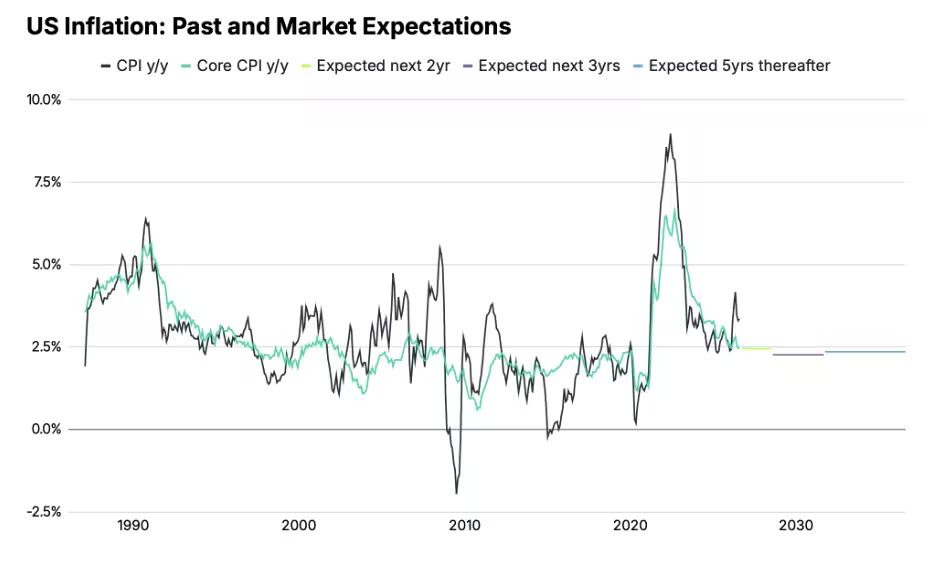
Much ink, literal and digital, has been spilled on the steady march higher of long-term interest rates. Coupled with this attention on rates has been renewed media focus on inflation, with both the Consumer Price Index (CPI) and Produce Price Index (PPI) coming in hot in recent weeks.
Yet when we decompose the rise in long-term rates, a curious picture emerges. Contrary to media sensationalism, fear of inflation does not seem to be in the driver’s seat. Indeed, as the following chart shows, inflation expectations remain reasonably well contained (for now at least)
Rather than being caused by higher inflation expectations, nominal yields have soared mostly due to a sustained rise in real yields, to levels not seen since 2009. This repricing reflects the market’s belief in very high levels of real growth in the U.S. economy.
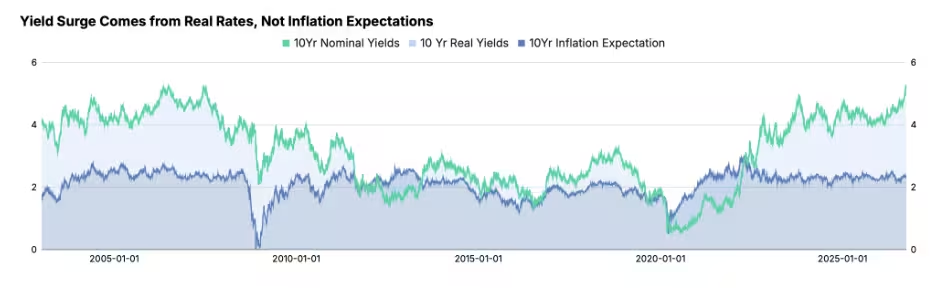
We see a contrarian opportunity in this repricing. At current levels, real rates may not be high enough to represent a “yield of dreams”, but they do offer what appears to be a juicy chance to play a potential slowdown in the economy. As such, Treasury Inflation-Protected Securities (TIPS) strike as presenting a compelling risk-reward trade-off currently.
The Long and the Short of It
When we look at the yield curve, we continue to favor owning the short end over the long end. The short end benefits from the comparable lack of duration risk, for starters. But we also think that the market may be pricing in too many rate hikes—especially given the weak September jobs report. Should that print not be a one-off, we could see many of the priced-in hikes disappear. On the long end, the risk is that inflation expectations increase from here as investors become more focused on the lack of fiscal sustainability in developed market economies. So, while a 5.60% yield-to-maturity on long-dated U.S. paper is much better than it was a few years ago, we’d be cautious in suggesting that level represents a ceiling.
Credit Spreads into the Haves and Have-Nots
We’re starting to see credit spreads widening in particular sectors as investors become more judicious about what they’re willing to hold. Case in point: Some French corporate champions’ bonds now trade inside (i.e. at a lower yield) than the French government itself. This, of course, is quite the reversal from the typical state of affairs, where government debt has been the ultimate risk-free benchmark against which all other debt is compared.
Within corporate debt, spreads are diverging—and nowhere is this more evident than in AI-related names. The hyperscalers, for instance, continue to enjoy tight credit spreads relative to government debt, as they have the free cash flow to finance their borrowing. Meanwhile, others, like CoreWeave, don’t generate the necessary cash flow to borrow but instead rely on third party-guarantees from the likes of Nvidia. For this latter group of AI borrowers, the market is becoming increasingly wary and reflected in widening credit spreads. We may be seeing meaningful idiosyncratic risk seep into the credit space, but also potential opportunities when the market prices in scenarios that could be far too bleak.
EM Debt an Emerging Winner
Another area in which this credit cycle has been different can be seen in the performance of Latin American debt. For decades, bond investors have been very wary of these bonds. But with some governments in the region notably moving to the right, fears of runaway spending have moderated. So Peruvian debt has outperformed the debt of an Eastern European country like Lithuania, to use one example.
Time to Order OATs?
It’s no secret that French government bonds (known as OATS) have risen dramatically in recent weeks amid fears about the nation’s finances and well-publicized civil unrest. Our take? We think the rise in yields has been too far, too fast, but we wouldn’t suggest buying French government debt, either.
Wrapping Up: Stay Liquid, Consider LQID
Given our outlook, we think investors may wish to give the Kurv Enhanced Short Maturity ETF (LQID) a look. LQID could benefit if we’re right that the market is mistaken that the Fed is on course for a flurry of rate hikes.
Article as of October 21 2026
Definitions:
CPI: A key economic indicator calculated monthly by the U.S. Bureau of Labor Statistics that measures the average change over time in the prices paid by urban consumers for a market basket of consumer goods and services
PPI: Key economic indicator that measures the average change over time in the selling prices received by domestic producers for their output
TIPS: Treasury Inflation-Protected Securities, or TIPS, are inflation-protected bonds (IPBs) that are issued by the U.S. Treasury.
Duration risk: The potential for a fixed-income investment's market price to decline because of a rise in interest rates.
OATs: The term OAT in finance most commonly refers to French government bonds (Obligations Assimilables du Trésor).
LQID Fund Risks: The Fund is an actively managed exchange-traded fund (“ETF”). The Fund’s investment adviser seeks to fulfill the Fund’s investment objective by using two income strategies: (1) an interest income strategy and (2) an income-generating option strategy on fixed income instruments.
(1) Interest income strategy: The Fund will be investing in a diversified portfolio of Fixed Income Instruments and Exchange Trade Funds (ETFs) of varying maturities, which may be represented by forwards. “Fixed Income Instruments” include bonds, debt securities, and other similar instruments issued by various U.S. and non-U.S. public- or private-sector entities. The average portfolio duration of this Fund will vary based on Kurv’s market forecasts and will normally not exceed two year. Duration is a measure used to determine the sensitivity of a security’s price to changes in interest rates. The longer a security’s duration, the more sensitive it will be to changes in interest rates. The dollar-weighted average portfolio maturity of the Fund is normally not expected to exceed three years.
(2) Option income strategy: To generate additional income, the Fund employs an exchange-traded and over-the-counter (“OTC”) option writing strategy on fixed income instruments. These fixed income instruments may include instruments such as exchange-traded funds, futures contracts, or interest rate swaps, linked to the short-term rates like the federal funds rate (the target interest rate range at which commercial banks borrow and lend their excess reserves to each other overnight, as set by the Federal Open Market Committee) or linked to short-term government securities like U.S. Trea