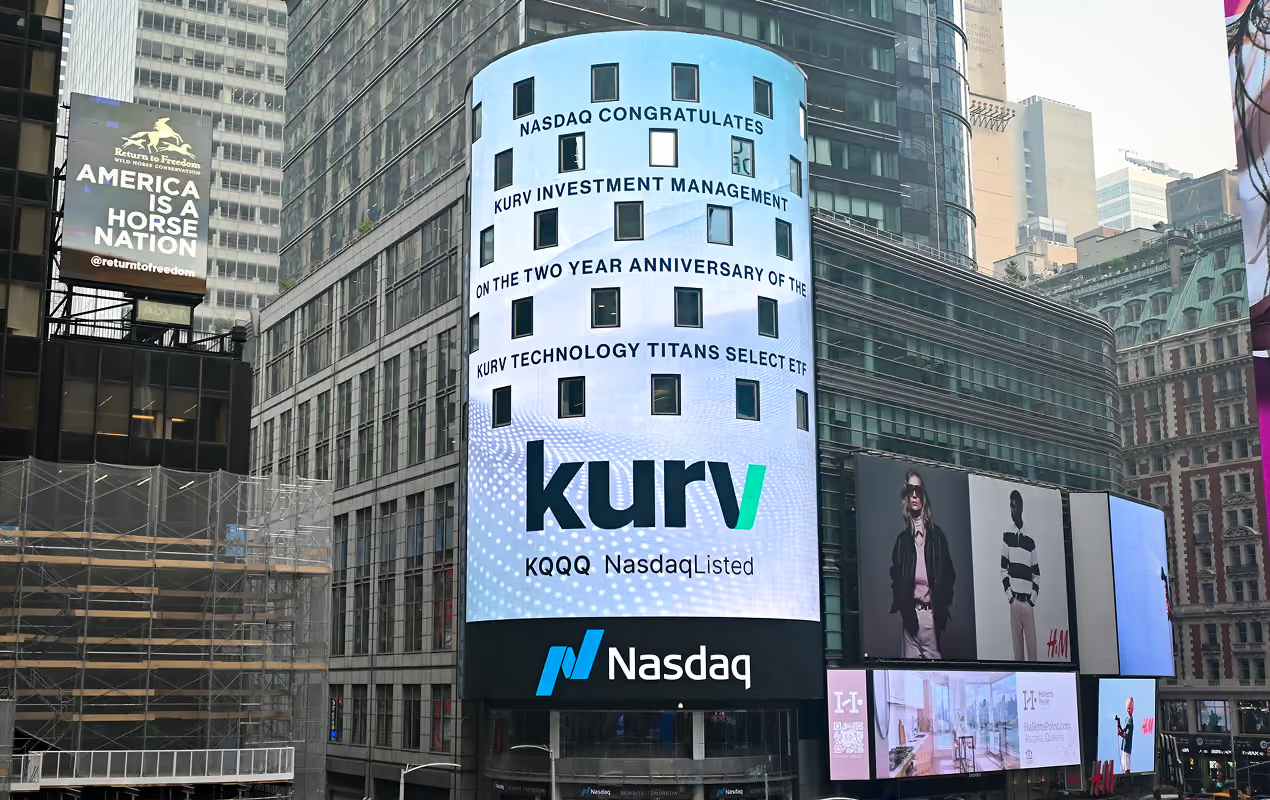
Not long ago, there was a distinct separation between the strategies available to institutional investors and those accessible to retail. As such, average investors were effectively shut out from potentially effective approaches to portfolio management that could enhance their risk-adjusted returns.
Increasingly, though, institutional-grade investment strategies are available to retail investors. Among these, Portable Alpha is arguably one of the more important approaches—and Kurv Investment Management is a leader in bringing it to a wider audience.
What is Portable Alpha?
In a nutshell, Portable Alpha seeks to provide exposure to a benchmark (a ‘beta’), while simultaneously pursuing outperformance (‘alpha’) using a separate strategy. Conceptually, the latter strategy is ‘ported’ onto the former to enhance its returns. Derivatives such as swaps and options—which do not require significant upfront cash commitments—are employed to gain exposure.
As Return Stacked notes:
Portable alpha rests on the principle that asset allocation and alpha generation are distinct pursuits. This separation allows investors to manage risk and potentially enhance returns without drastically altering their asset allocation.
What’s more, they observe:
Portable alpha’s history stretches back to the 1980s, with PIMCO’s StocksPLUS strategy among the earliest examples. This strategy collateralizes equity index derivatives with an actively managed short-term bond portfolio, aiming to provide alpha from credit selection in addition to stock market returns.
This is a crucial point. From an alpha standpoint, large cap equities and fixed income are not alike. It is very difficult for active managers to outperform indices such as the S&P 500 or Nasdaq-100. The data bears this out: According to Morningstar, 76% of active large-cap blend managers failed to beat their benchmark in 2023. And over a longer time horizon, the underperformance of stock-pickers becomes even more pronounced—from 2014 to 2023, fully 90% of active U.S. large-cap blend managers underperformed their benchmark.
But the same cannot be said of fixed income, where active management can help deliver alpha to investors. This opens the door to investors porting alpha from fixed income onto their equity exposure (a technique also referred to as Return Stacking). What’s necessary, as alluded to above, is to achieve the beta exposure (i.e. to an equity index) efficiently. So rather than buying the cash S&P 500, for example, a portfolio manager can use swaps, futures or options which require less of a capital commitment. This frees up capital to pursue alpha via fixed income.
The Kurv Difference
What makes Kurv Investment Management stand out is the institutional background of its leadership. This history means that Kurv can offer sophisticated investment strategies such as Portable Alpha to retail investors.
Howard Chan, Kurv’s CEO and Founder, brings over two decades of experience across investment management, strategy, and asset allocation. Prior to Kurv, he held roles at Goldman Sachs Asset Management, where he focused on asset allocation for institutional and private wealth clients. In addition, Howard managed global fixed-income strategies at PIMCO.
Dominique Tersin, Kurv’s Lead Portfolio Manager, also has significant experience with institutional investments. Specializing in derivatives, ETFs, and liquidity management, he previously was a Portfolio Manager at PIMCO, where he managed enhanced liquidity programs firmwide as well as European ETF trading operations.
Portable Alpha in Action: Meet the Kurv U.S. Large Cap TaxOptimized Strategy
The Kurv U.S. Large Cap TaxOptimized Strategy seeks to exceed the total return of the S&P 500 index by providing passive exposure to U.S. large cap equities through ETFs and options, while maximizing sources of after-tax return through active collateral management in municipal bonds (‘munis’) and preferred stocks.
There are three important use cases for this version of Portable Alpha:
- The Strategy can replace dividend equity in an investor’s portfolio. It seeks to generate higher levels of risk-adjusted after-tax income, in part due to the tax-advantaged nature of municipal bonds in the U.S. The Strategy may also reduce sector and stock bets, while also consolidating portfolio management under one umbrella.
- By porting potential fixed income outperformance onto the equity beta, the Strategy replaces passive equity in an investor’s portfolio. As a result, it offers investors the opportunity to help generate returns exceeding the benchmark S&P 500 index.
- The Strategy is a capital-efficient solution that consolidates two betas into one line-item. In so doing, it may free up an investor’s capital, allowing an individual to deploy cash elsewhere or to use for lifestyle purposes.
To learn more about how Kurv’s Portable Alpha strategy has the potential to take your portfolio to the next level, please visit https://www.kurvinvest.com/etf/lcto
Tax optimization strategies may reduce taxable income but cannot eliminate taxes, and there is no assurance the strategy will achieve its objectives.