Overall Metals Market
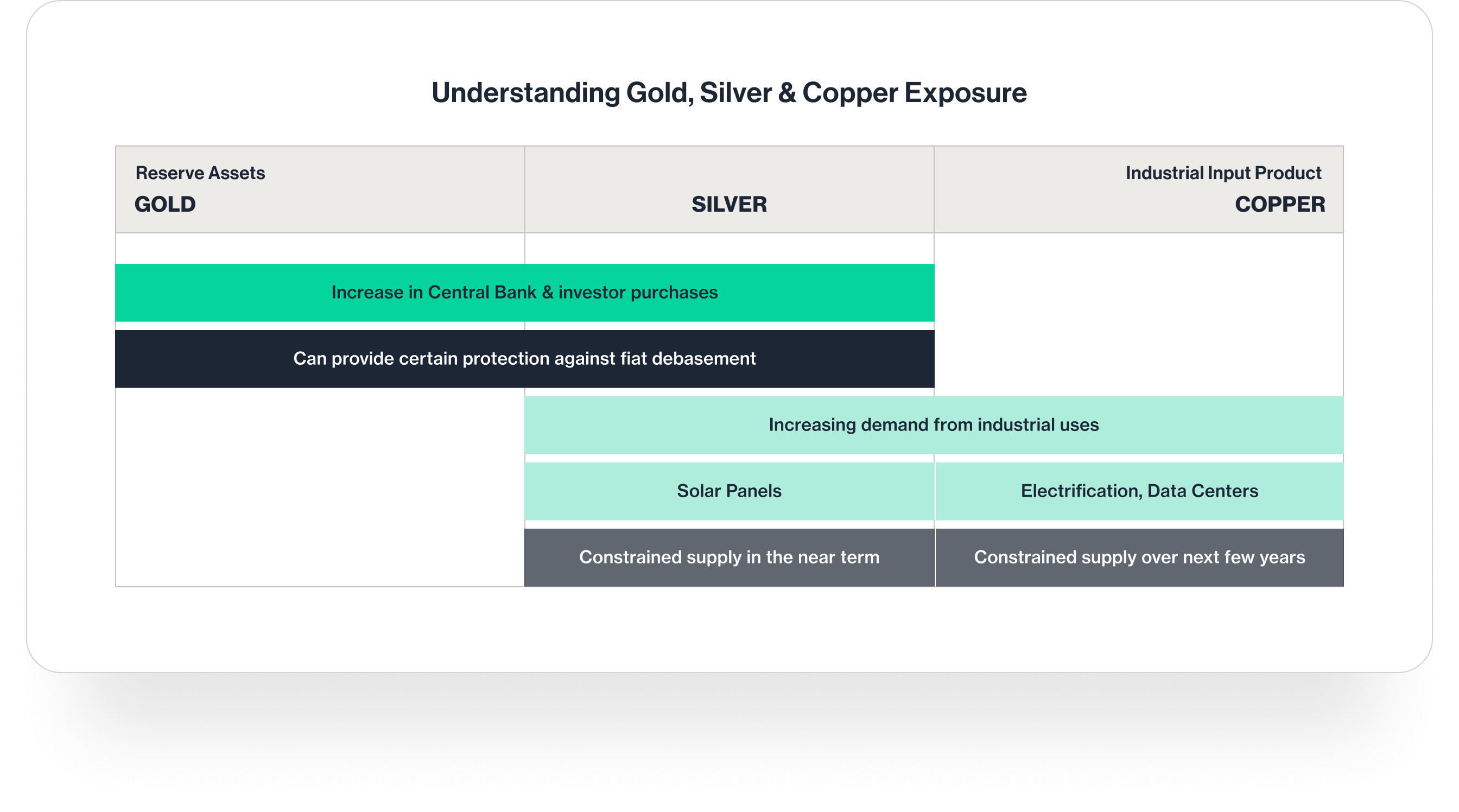
We’ve written previously about our bullish outlook for gold and silver. Our optimism starts with the case for gold, which is almost exclusively a precious metal. Gold continues to benefit from the debasement trade: Investors (including central banks) seek to diversify away from developed markets currencies and government bonds in favor of a haven that cannot be printed at will.
Driving this trade is a recognition that sky-high debt to GDP ratios in key countries (such as the U.S.) are only likely to increase given the path of fiscal policy. Indeed, the federal government’s current deficit is practically unheard of outside of a recession, and any downturn will only exacerbate the imbalance between revenues and spending. Investors correctly (in our view) sense that governments will resort to inflating away the burden of the accumulated debt.
More recently, some market participants have no doubt also moved into gold given the Trump administration’s trade policies. It’s entirely possible that the rising protectionism will dent the appeal of holding the U.S. dollar as a reserve currency.
Moving to Silver
If we think about metals as a spectrum from precious to industrial, silver sits right in the middle. It has significant industrial applications and plays a role as a haven alongside gold). As we recently observed:
According to the Silver Institute, 2025 provisionally saw a deficit of around 95 million ounces. (For context, demand was on the order of 1.1 billion ounces).
Industrial silver demand accounts for 665 million ounces annually and shows little sign of meaningfully letting up. For example, silver to be used in solar panels now represents 17% of overall demand—double that of a decade ago.
Silver is often referred to as the poor man’s gold, given its significantly cheaper price per ounce. That makes it especially enticing to investors when gold goes on a big run to the upside. We’ve seen this dynamic play out since mid-2025. Gold took off, initially leaving silver in the dust (the gold-silver ratio touched 100). But then investors gravitated to silver as a catch-up trade, and it did not disappoint: Silver recently spiked to $120, sending the ratio cratering to 46.
Now to Copper
Copper is at the opposite end of the metal spectrum, being a purely industrial commodity. It often serves as a leading indicator of industrial demand and global growth, given its use in sectors such as housing and infrastructure. More recently, analysts believe copper is an important part of the AI infrastructure buildout—and one that enjoys superiority to silver given its electrification qualities and relative cost- effectiveness. Beyond AI, copper is a play on the decarbonization trend given its use in the nuclear power industry.
It’s important to underscore some of the geopolitical trends at play with copper. Similar to silver, production is biased in the west while demand is concentrated in the east—raising critical resource sovereignty issues. Complicating the supply side of the equation is the fact that while the West has a large share of global mine production, smelting capacity is increasingly the domain of China.
There’s also a growing trend for nations to seek natural resource independence, leading to countries establishing strategic reserves, which could drive a “super cycle” in natural resources. Indeed, there are reports of strategic stockpiling of copper by the China—which may be a reason why prices have held up despite the slump in the Chinese housing market.
Important Information:
The foregoing is general market and economic commentary prepared by Kurv investment professionals as of 02/10/2026. The commentary is neither to be construed as general investment advice nor personalized investment advice. Our commentary is subject to change based upon our views of market, economic, political and related factors. We are under no obligation to provide updated commentary if our views change. To the extent the commentary covers market segments, market sectors, industries, commodities or other securities please note that Kurv professionals may effect transactions in such market segments, market sectors, industries, and commodities or other securities which presents a conflict of interest. All Kurv investment professionals are subject to the firm’s Code of Ethics policy.
For more information on Kurv Investment Management please visit www.kurvinvest.com.